Monday, November 29, 2010
Look at Them Looking.mov
On Wednesday, November 03, 2010, we visited the Metropolitan Museum of Art in New York City, NY. We created this video, combining sketches that were drawn and sounds that were recorded during our experience in the John Baldessari: Pure Beauty exhibit.

Blurring Binary Boundaries
Having passed the guarded gate and carefully pinned on the museum badge signaling our permission to enter, we proceeded up the staircase and through hallways decked with well-known sculptures, paintings, and whispering tourists and aficionados. There was no doubt that we were in a public art museum with clearly defined limits.
Yet, upon entering the all-white walled space of the John Baldessari: Pure Beauty exhibit at the Metropolitan Museum of Art, we were instantly thrown into a world where boundaries are blurred: what seemed to be a purely functional documentation of the past locations of the exhibit was in fact the first piece of the exhibit, a room with paintings hung on its walls was also filled with a soundtrack broadcast from an unseen location, fellow museum visitors planned a dinner party as security guards surreptitiously jotted down notes. One museum visitor captured the crux of the issue, saying to her friend “How do you navigate that boundary?”
How does the art museum visitor navigate the binary boundaries between public and private, art and life, presence and absence?
In his essay “Of Other Spaces”, French philosopher Michel Foucault describes the museum as a heterotopia. Heterotopias, according to Foucault, are “effectively enacted utopias in which the real sites...are simultaneously represented, contested, and inverted...[and] are absolutely different from all the sites that they reflect and speak about” (Foucault 1986, 24). Foucault suggests that a site is defined by its set of relations, and a heterotopia is one of the two types of particularly interesting sites that “suspect, neutralize, and invert the set of relations that they happen to designate, mirror, or reflect” (24). Perhaps a good way to think of a heterotopia is a place that draws attention to, and potentially critiques, certain aspects of social relations. In his essay, Foucault exemplified one type of heterotopia, heterotopias of time (or heterochronies), with the museum, as the museum is a space detached from the elapse of time (26).
For the Baldessari exhibit, as we contemplate the relationships between the museum, the museum visitors whose observations of art we observe, the security guards who watch us, and ourselves in the art exhibit, we entertain the idea that, in addition to a heterotopia of time, museums can also be a heterotopia of boundaries, where the lines between dichotomies are suspended, challenged, explored, and permeated. Because the contemporary museum is a distinctively public presentation of art, the museum obviates the museum visitors from the need to delineate the boundaries between public and private, art and life, and presence and absence, and allows these boundaries to blur. In other words, by being what it is, the museum grants permission to the museum visitors to explore these nebulous distinctions, and serves as a heterotopia of boundaries
In the following posts, we explore the ways in which different boundaries are blurred.
Yet, upon entering the all-white walled space of the John Baldessari: Pure Beauty exhibit at the Metropolitan Museum of Art, we were instantly thrown into a world where boundaries are blurred: what seemed to be a purely functional documentation of the past locations of the exhibit was in fact the first piece of the exhibit, a room with paintings hung on its walls was also filled with a soundtrack broadcast from an unseen location, fellow museum visitors planned a dinner party as security guards surreptitiously jotted down notes. One museum visitor captured the crux of the issue, saying to her friend “How do you navigate that boundary?”
How does the art museum visitor navigate the binary boundaries between public and private, art and life, presence and absence?
In his essay “Of Other Spaces”, French philosopher Michel Foucault describes the museum as a heterotopia. Heterotopias, according to Foucault, are “effectively enacted utopias in which the real sites...are simultaneously represented, contested, and inverted...[and] are absolutely different from all the sites that they reflect and speak about” (Foucault 1986, 24). Foucault suggests that a site is defined by its set of relations, and a heterotopia is one of the two types of particularly interesting sites that “suspect, neutralize, and invert the set of relations that they happen to designate, mirror, or reflect” (24). Perhaps a good way to think of a heterotopia is a place that draws attention to, and potentially critiques, certain aspects of social relations. In his essay, Foucault exemplified one type of heterotopia, heterotopias of time (or heterochronies), with the museum, as the museum is a space detached from the elapse of time (26).
For the Baldessari exhibit, as we contemplate the relationships between the museum, the museum visitors whose observations of art we observe, the security guards who watch us, and ourselves in the art exhibit, we entertain the idea that, in addition to a heterotopia of time, museums can also be a heterotopia of boundaries, where the lines between dichotomies are suspended, challenged, explored, and permeated. Because the contemporary museum is a distinctively public presentation of art, the museum obviates the museum visitors from the need to delineate the boundaries between public and private, art and life, and presence and absence, and allows these boundaries to blur. In other words, by being what it is, the museum grants permission to the museum visitors to explore these nebulous distinctions, and serves as a heterotopia of boundaries
In the following posts, we explore the ways in which different boundaries are blurred.
Art and Life: Conversations That Mirror Paintings
In the posts with the title "Art and Life: Conversations That Mirror Paintings", we have posted replications of some of the art in the Baldessari exhibit, along with corresponding conversations that we overheard while viewing the art! We have linked the images with the web source that we used for the replications.
Public/Private
In “Wondrous Difference”, Alison Griffiths focuses on the development of the Natural History Museum in suggesting that museums are socially constructed public spaces which were created to enforce behavioral norms including “dress, decorum, and comportment” (Griffith 2002, 9). Museum space is intended as a socially enforced public space that is accessible to everyone. Shared among the public, there is an assumed social and behavioral code to which museum patrons are expected to conform, i.e. speaking quietly or preferably not at all, walking through the exhibit in the same direction and pace, and keeping a certain distance between observers and art-objects. These codes are behavioral ways to delineate the public nature of the museum.
By conforming to these codes, one highlights the distinction between how one behaves in the public space, and how one behaves in private. In our particular museum experience, despite the existence of this distinction, we found a wide range of public and private behaviors. Some patrons followed the social code to refrain from talking, and walked through the exhibit at a generally slow but steady pace, periodically stopping to take in a particular piece of art and perhaps share some commentary with the person with whom they came. For example, one couple we observed walked through the exhibit space carrying on a passionate conversation regarding their relationship. The conversation was private due to its the content, but also in the sense that they were only addressing each other, paying little attention to their surroundings. The conversation nonetheless took place in a public space with many people around-- it was a private conversation with a public audience in mind, breaching the boundary between public and private.
Although the couple broke the social museum code of silence while observing art, they followed the general walking direction, the pace, and the museum etiquette of stopping periodically to seem as though they were engaging with the art. It seemed almost as if the assumption that other patrons’ attention would be directed to the exhibit made the space feel private enough for them to have that conversation.
Another example of the play between public and private was a group of ten women guided by a tour guide. These ten women looked like they were in their early to mid 30’s, all were well-groomed and stylish. The guide was not affiliated with the museum, and her clothing style, age, and general appearance blended in quite well with the ten women who were listening. The guide took them through each exhibit room, giving detailed explanations to each piece she found particularly salient. The guide had a gentle but well-projected voice that carried easily, and the tour group formed a formidable presence in each exhibition room. We noticed whenever the guide took the ten women into the room, conversations amongst other museum visitors would quickly die down, and soon move onto the next room. It was almost as if by being so publicly present, the guide’s voice combined with the force of the women’s group marked an exhibit room their own, in other words private. The women would casually make some friendly comments or jokes with each other, and every now and then one of the museum visitors would surreptitiously follow the group to listen in for a little bit. In that sense, this privately formed group-- they all seemed to know each other, and the guide was not provided by the museum-- was performing their art observing in public.
In short, we observed that while museums seem indubitably public, the boundary between public and private was constantly challenged and permeated.
By conforming to these codes, one highlights the distinction between how one behaves in the public space, and how one behaves in private. In our particular museum experience, despite the existence of this distinction, we found a wide range of public and private behaviors. Some patrons followed the social code to refrain from talking, and walked through the exhibit at a generally slow but steady pace, periodically stopping to take in a particular piece of art and perhaps share some commentary with the person with whom they came. For example, one couple we observed walked through the exhibit space carrying on a passionate conversation regarding their relationship. The conversation was private due to its the content, but also in the sense that they were only addressing each other, paying little attention to their surroundings. The conversation nonetheless took place in a public space with many people around-- it was a private conversation with a public audience in mind, breaching the boundary between public and private.
Although the couple broke the social museum code of silence while observing art, they followed the general walking direction, the pace, and the museum etiquette of stopping periodically to seem as though they were engaging with the art. It seemed almost as if the assumption that other patrons’ attention would be directed to the exhibit made the space feel private enough for them to have that conversation.
Another example of the play between public and private was a group of ten women guided by a tour guide. These ten women looked like they were in their early to mid 30’s, all were well-groomed and stylish. The guide was not affiliated with the museum, and her clothing style, age, and general appearance blended in quite well with the ten women who were listening. The guide took them through each exhibit room, giving detailed explanations to each piece she found particularly salient. The guide had a gentle but well-projected voice that carried easily, and the tour group formed a formidable presence in each exhibition room. We noticed whenever the guide took the ten women into the room, conversations amongst other museum visitors would quickly die down, and soon move onto the next room. It was almost as if by being so publicly present, the guide’s voice combined with the force of the women’s group marked an exhibit room their own, in other words private. The women would casually make some friendly comments or jokes with each other, and every now and then one of the museum visitors would surreptitiously follow the group to listen in for a little bit. In that sense, this privately formed group-- they all seemed to know each other, and the guide was not provided by the museum-- was performing their art observing in public.
In short, we observed that while museums seem indubitably public, the boundary between public and private was constantly challenged and permeated.
Art and Life: Conversations That Mirror Paintings #1
Pelicans Staring at a Woman With Nose Bleeding

Conversation #1:
" Yea he was the grandfather of conceptual art in the 70s. He led the movement of conceptual art in California."
-Man with two younger men (perhaps his students?)
" This just looks like a disaster."-One young man's response
Conversation #2:
"I would just love to have that."
"Yea I looooooove pelicans."
Art/Life
In his essay “The World as Exhibition,” Timothy Mitchell detailed an epistemological exploration of representations of the Orient in relation to “the West” and found that “[w]hat they found in the West...were not just exhibitions of the world, but the ordering up of the world itself as an endless exhibition” (Mitchell 1989, 218). Through this exploration, Mitchell is essentially challenging the division between “a realm of mere representations and a realm of the real; exhibitions and an external reality; an order of mere models, descriptions, or copies and an order of the original” (236). Extending from Mitchell’s ideas, we examined the boundaries between art (representations) and life (reality).
Another traditional bifurcation particularly noticeable in a museum setting is the opposition of art and life. Museums house objects of art, not life, and even the event of visiting a museum is a departure from the daily grind of life for most people. The interaction between the arrangement of the exhibits, and the museum visitors upon whom our group gazed (quite intensely), however, challenges the boundary between the realms of art and life.
Baldessari himself was perhaps asserting a critique on this boundary: the first piece in the exhibit is one that documents where the exhibit has been before. The documentation is part of life- whether or not Baldessari chooses to display it, documentation of the work by this prolific artist is someone’s daily grind. But here it is also art- framed and hung high, protected from curious hands and for all art observers to see.
The gift shop is another instance of blurring the boundary between art and life. There were two gift shop areas near the Baldessari exhibit: one at the end of the exhibit, the other integrated into the main corridor of the second floor of the Metropolitan Museum. The latter is not a partitioned off area of merchandise; it was a few "islands" with replicas of Baldessari's works. There was not a clearly marked separation between the coffee mugs and canvas totes printed with Baldessari quotations, and a corridor inhabited by paintings by other master painters.
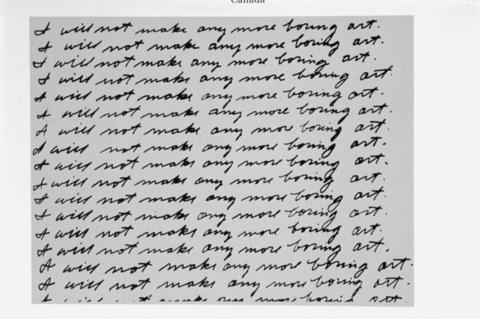
The souvenirs in the gift shop were also curious. Baldessari's conceptual art focuses on the concepts conveyed, rather than the material vehicles of these concepts. So if a mug is printed with "I will not make any more boring art," which is Baldessari’s concept, and thus Baldessari's art, then the mug is as proficient a vehicle as the medium Baldessari originally used. It is art. At the same time, even if the mug was never used to drink coffee, its form of a mug refers to one of the most quotidian morning routines of daily life. Also in the exhibits’ gift shop, a set of four red balls were sold with instructions for the museum visitors to take them home, throw them in the air, and take pictures of the red balls mid-air, following the style of many of the Baldessari works. The mug and the red balls extend Baldessari's work into the buyer’s life, making it hard to tell where life starts and art ends, and where art ends and life starts.
The people in the museum also challenged us to think about the boundary between art and life. For example, while the museum security guards refused to talk to us about their work or the artworks, they had conversations among themselves. We overheard one security guard complain to another about constant fatigue; his colleague then suggested that he drink some orange juice. Their utterances on mundane concerns of daily life mingled with the voices on the soundtracks from Baldessari's video artworks in the next room, as well as with the voices of museum tour guides explaining the significance of each piece in the exhibit. Our group couldn’t help noticing how in the interaction of all these voices, art and life blurred together.
We also interviewed several museum visitors. For some, visits to the art museum seemed motivated by an interest in the transcendental qualities of art, which was also part of their lives. The first person we interviewed was a tall man dressed in casual jeans and sneakers. When asked to talk about his museum experience, he responded that he was only there to accompany his friend, who has a passion for art. When asked if they were there specifically to see the Baldessari exhibit, he said yes, although his friend had made that decision. He said, "I don't know anything about modern art, or art really, but this seems interesting, and I would love to learn more about it... I am just here to hang out with my friend." When asked if his friend tells him things about art, he said, "Well, yeah, we talk about it."
Across the room, we interviewed this man’s friend. She was a petite woman dressed in a white wool coat, who revealed that she is an art professor and museum curator in France. When asked about her visit, she said that she came specifically for the Baldessari exhibit. "The art is [kisses fingers] exquisite!" said the art professor with French accent, “But the space is awful. It should have been...eh...it should have been shown in its original context." The woman then asked if one of our group members is an art student, to which she responded no. When asked about her trip, and she said that she came to New York to visit her friend, but will no doubt also visit the major art museums in New York.
Prior to approaching them for interviews, we observed this man and his friend, the art professor, from a distance. The two of them rarely conversed and often looked at different pieces. Both of them, on their own and in different paces, gazed at the pieces, read the text descriptions, and occasionally took a step back, gasping or sighing. The purpose of a visit to an art museum is usually for art, and both of them were absorbed by their appreciation of the pieces hanging on the walls. But for both this man and his friend, the art professor, observation and the appreciation of art also served a social function that allowed them to spend time with each other. The appreciation of art became a mode of connection in their friendship, so in each piece observed (and likely discussed later), and in each sigh of exhilaration, a social relationship between two art observers was established and maintained. The idea of "going to see art" gives structure to a visit with a friend. "Talking about it" later outside the museum extends the boundary of this exhibit into daily life.In short, for this man ad his friend the art professor, art and life are blurred together.
In our group’s observation, art and life co-exist in the pieces exhibited in the museum, in the souvenirs and reflections people can bring home from the museum and into their individual lives, and in the way people engage with the museum. Thus the boundary between art and life is blurred. For us, the question of "where does the exhibit end?" became unanswerable in a very real sense.
Subscribe to:
Posts (Atom)